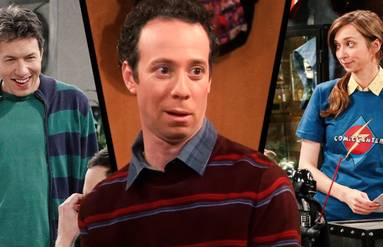
For years, Stuart Bloom lingered in the background of The Big Bang Theory—quiet, underconfident, perpetually broke, and always just outside the circle. He ran the comic book store, took beatings in paintball, and existed on the periphery of genius. Now, in a bold pivot from Chuck Lorre and Steven Molaro, Stuart Fails to Save the Universe flips the script, placing the once-sidelined character at the center of a sci-fi comedy with existential stakes—and a surprisingly human heart.
The first look at the upcoming Big Bang Theory spinoff has arrived, and it’s not what fans expected. Far from a retread of Leonard, Sheldon, and Penny’s apartment dynamics, this new series leans into absurdity, emotional vulnerability, and cosmic chaos—all through the lens of the franchise’s most overlooked character.
Why Stuart? The Unlikely Hero of a Franchise Shift
Stuart was never supposed to carry a show. On The Big Bang Theory, his role was comedic relief with a melancholy edge—a man whose dating struggles, anxiety, and financial instability made him an audience surrogate for unfulfilled potential. But that’s precisely what makes him compelling now.
Stuart Fails to Save the Universe doesn’t try to make him brilliant or heroic in the traditional sense. Instead, it asks: What if the universe didn’t need another genius? What if it needed someone who’s used to failing—and getting back up anyway?
The pilot opens with Stuart accidentally triggering a quantum rift while attempting to repair a vintage arcade cabinet in the back room of The Comic Shop. Suddenly, bizarre entities appear—interdimensional beings who mistake Stuart for a prophesied “Chosen Nerd” destined to prevent the unraveling of spacetime.
He’s not. But no one tells him that.
First Look: Tone, Visuals, and Easter Eggs
The first teaser footage, leaked at a recent Warner Bros. press event, shows a visual overhaul. Gone is the sterile Pasadena lighting of TBBT. In its place: neon-drenched comic shop backrooms, surreal dream sequences involving anthropomorphized comic book villains, and intergalactic landscapes rendered with a hand-drawn, slightly off-kilter aesthetic—reminiscent of Rick and Morty meets Scott Pilgrim.
Kevin Sussman reprises his role, but with a noticeable shift. The hesitant, soft-spoken Stuart is still present—but now layered with dry, self-deprecating wit and moments of accidental courage. In one scene, he tries to negotiate with a being made of sentient dark matter using comic book pricing logic: “Look, I’ll give you 75% off a back issue of Silver Surfer #52 for your cooperation.”
The show’s tone balances satire with genuine emotional beats. A recurring motif: Stuart calling his mother mid-crisis, pretending everything is fine while dodging black holes.
Supporting Cast: Familiar Faces and New Forces
The spinoff smartly avoids isolation. While Stuart is the lead, he’s not alone. The supporting cast bridges the old and new worlds:
- Denise (played by Tichina Arnold), Stuart’s no-nonsense sister, runs a struggling laundromat that becomes an interdimensional nexus. Her skepticism grounds the show’s wilder elements.
- Lila, a teenage goth clerk at The Comic Shop (new character), serves as Stuart’s reluctant sidekick. She’s more competent than he is but respects his “weird luck.”
- Dr. Vex, an exiled cosmic bureaucrat (voiced by W. Earl Brown), explains the rules of the collapsing multiverse with the tone of a DMV clerk. “You weren’t on the list, but the paperwork’s lost, so… you’re it.”
And yes—cameos are confirmed. Jim Parsons returns in voiceover as a hallucination of Sheldon, critiquing Stuart’s scientific methodology from beyond the grave. “Your hypothesis lacks peer review,” the ghostly voice intones as Stuart tries to jury-rig a portal with a Pop-Tart toaster.
The “Failure” Hook: Subverting the Chosen One Trope
What defines Stuart Fails to Save the Universe isn’t just its sci-fi trappings—it’s its core philosophy. Unlike typical hero journeys, Stuart doesn’t grow into competence. He remains awkward, underqualified, and overwhelmed. The universe keeps unraveling. Aliens keep getting confused. His plans fail—spectacularly.
But it’s through failure that progress happens.
In episode three, Stuart attempts to stabilize a collapsing timeline by reenacting The Breakfast Club with alternate-reality versions of himself. All versions fail. But the emotional honesty of the attempt creates a resonance that temporarily seals the rift.
The show argues that saving the universe isn’t about IQ or superpowers—it’s about showing up, being earnest, and occasionally making the right dumb decision.
This is The Big Bang Theory legacy turned inside out. Where that show celebrated intellect, this one celebrates emotional resilience. Where Sheldon solved problems with logic, Stuart stumbles into solutions through empathy.
Why This Spinoff Could Work—And Why It Might Not
Critics are skeptical. Can a character built on lack of confidence carry a serialized narrative? Is the universe-tied-to-comics premise too meta?
There are risks. The danger lies in leaning too hard into absurdity without emotional centering. Early test screenings showed some viewers confused by the tonal shifts—laughing at a scene meant to be poignant, or bored during a high-stakes multiverse chase.
But the show’s strength is in its restraint. Each episode ends with Stuart back at the comic shop, sweeping up, listening to voicemails from his mom, wondering if he made a difference. The universe may be saved—for now—but his rent is still due.
It’s this grounding that makes the show feel fresh. It’s not TBBT 2.0. It’s a spiritual successor that understands the original’s success wasn’t just about science jokes—it was about outsiders finding connection.
Behind the Scenes: The Creative Team’s Vision
Chuck Lorre and Steven Molaro are executive producing, but the day-to-day showrunner is Aisha Morales, a writer formerly on Ted Lasso and What We Do in the Shadows. Her influence is visible in the character-driven humor and focus on personal growth amid chaos.
In a recent interview, Morales said: > “Stuart was always the mirror to the main cast’s arrogance. He reminded us that not everyone gets to be a genius. But he also showed up every day. That’s heroic in its own way.”
Kevin Sussman, now a producer on the show, pushed for Stuart to remain flawed. “I didn’t want him to suddenly become cool or confident,” he said. “I wanted him to save the universe because he’s Stuart—not despite it.”
Marketing Push and Release Strategy
Warner Bros. is betting big. The first look debuted during the Super Bowl, sandwiched between a Harry Potter reboot teaser and a Game of Thrones prequel spot. The 30-second clip—featuring Stuart screaming, “I DON’T KNOW WHAT I’M DOING!” as a planet explodes behind him—went viral instantly.
The series will premiere on Max, with a seven-episode first season. Each episode is 28 minutes—short enough for bingeability, long enough for story arcs.
Merchandising is already underway: limited-edition Stuart Fails to Save the Universe variant comics, retro arcade game tie-ins, and even a mobile puzzle game where players “repair reality” by matching comic book panels.
What This Means for the Big Bang Theory Universe
This spinoff marks a significant evolution. Young Sheldon explored the past. Stuart Fails to Save the Universe leaps into the future—and sideways into other dimensions.
It also signals a shift in who gets to be a lead. No longer is the franchise about prodigies or child geniuses. It’s about the guy in the background who finally gets the spotlight—and doesn’t know what to do with it.
For fans who missed the gang but wanted something new, this offers a familiar voice with a fresh mission. It’s still about nerds, still full of jokes about comic books and cosmology—but now, the heart of the story beats a little louder.
Final Verdict: A Surprising, Human-Centric Leap
Stuart Fails to Save the Universe isn’t trying to replicate The Big Bang Theory. It’s trying to expand it—into messier, funnier, and more emotionally honest territory.
The first look proves the show has visual flair, comedic timing, and a lead actor who’s ready for his moment. Whether it lasts depends on its ability to balance absurd stakes with intimate storytelling.
But one thing is clear: for a character who spent a decade being forgotten, Stuart Bloom is now at the center of everything.
If the universe is going to be saved, it might just take someone who’s used to being overlooked to do it.
Watch the first episode. Laugh at the interdimensional paperwork jokes. Then pause when Stuart, alone in his apartment, whispers, “I tried.” That’s the moment you realize—this isn’t just a spinoff. It’s a quiet revolution.
FAQ
What should you look for in Stuart Fails to Save the Universe: First Look at New Spinoff? Focus on relevance, practical value, and how well the solution matches real user intent.
Is Stuart Fails to Save the Universe: First Look at New Spinoff suitable for beginners? That depends on the workflow, but a clear step-by-step approach usually makes it easier to start.
How do you compare options around Stuart Fails to Save the Universe: First Look at New Spinoff? Compare features, trust signals, limitations, pricing, and ease of implementation.
What mistakes should you avoid? Avoid generic choices, weak validation, and decisions based only on marketing claims.
What is the next best step? Shortlist the most relevant options, validate them quickly, and refine from real-world results.